

Young Malaysians shine at AI hackathon for plantations
Mon, 9th Nov 2026 (Today)
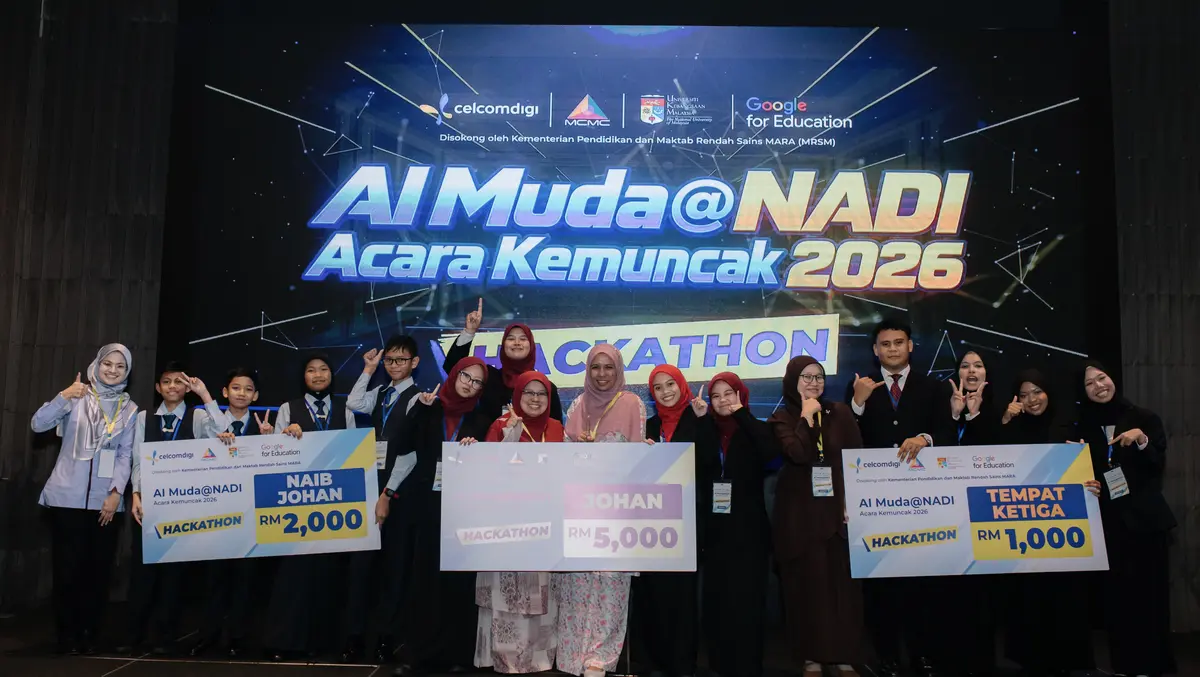
Young Malaysians showcased artificial intelligence projects at the national AI Muda@NADI Hackathon 2026, which brought together 26 finalist teams from schools across Malaysia.
The competition focused on ideas for Malaysia's plantations and commodities sector under the theme AI Innovation for the Future of Plantations and Commodities. Students from Form 1 to Form 6 developed projects on sustainability, plantation productivity, smart farming, environmental conservation and commodity innovation.
The winning team was INNOVIQ from Kolej Vokasional Perdagangan Johor Bahru. Its project, TerraScan, is a smart agriculture application that combines soil analysis, crop recommendations, weather forecasting, farm simulation and financial management.
The application was designed to help farmers make better decisions on crop planning and operations. The team received RM5,000, while the second- and third-placed teams received RM2,000 and RM1,000 respectively.
National programme
The hackathon was the final stage of AI Muda@NADI, part of the AI@NADI Training Programme 2026. The programme was implemented by the Malaysian Communications and Multimedia Commission in collaboration with CelcomDigi through the National Information Dissemination Centres, known as NADI.
More than 9,000 secondary school students completed six online learning modules before the hackathon. They covered prompt engineering, the responsible use of artificial intelligence, creative content development, and the use of AI in learning and productivity.
After completing the modules, students submitted their work through an online assessment system built for AI Muda@NADI. Judges selected the 26 finalist teams based on four components: AI apps developed using vibe coding, AI videos, AI prompt trails and AI project cards.
Entries were assessed on the problem identified, the proposed AI solution, its relevance to Malaysian challenges and its alignment with the Sustainable Development Goals. Each team consisted of four students and one supervising teacher from the same school.
Finalists represented schools from every state in Malaysia, giving the programme a nationwide footprint. It also linked classroom learning with practical competition, taking students from online training to project development and presentation.
Partners involved
AI Muda@NADI is conducted in partnership with Universiti Kebangsaan Malaysia's Faculty of Education and Google for Education. The programme also has support from the Ministry of Education and Maktab Rendah Sains MARA.
The initiative reflects a broader push in Malaysia to expose students to applied artificial intelligence earlier in their education. By tying the competition to agriculture and commodities, organisers directed participants towards one of the country's established economic sectors rather than consumer-facing digital products alone.
That emphasis was visible in the finalists' projects, which focused on farming efficiency, environmental management and production challenges. The theme also highlighted the use of digital tools in industries that remain significant to Malaysia's economy.
T. Kugan commented on the programme's approach and reach. "Through AI@NADI, CelcomDigi brings together public-sector leadership, academic expertise, technology capabilities and communities to translate AI ambitions into practical learning opportunities. By connecting these strengths, we can help more young Malaysians develop relevant skills and explore how AI can address real-world challenges, preparing them for opportunities ahead in a digital nation," said T. Kugan, Chief Enterprise Business Officer and Acting Chief Innovation Officer at CelcomDigi.